Objectives:
- To devise creative and innovative ideas for new products and services inspired by ‘low value’ items from the Pound Shop.
- To recognise, create and evaluate opportunities for new products and services.
- To work in groups to negotiate ideas and present on a chosen proposed product or service.
These are the learning outcomes for the session and are outlined to participants at the start of the activity.
Overview:
This activity was developed to stimulate the entrepreneurial competencies of ‘creativity’ and ‘opportunity recognition’. Creativity and Opportunity recognition have been recognised as essential elements of the entrepreneurial process (Morris et al; 2013) and skills that enterprise educators should be developing with their students (QAA, 2018). In recognition that entrepreneurial activity requires collaboration with others, the exercise was also designed to be conducted with small groups thereby targeting the development of participants’ team working skills.
Students are given a range of ‘low value’ items and they must work in small groups to brainstorm new products and services that utilise the original item but produce greater value. This is a non-assessed activity.
Activity: Total time – 2.5 hours
(1st hour) – The educator uses a short powerpoint to outline to the entire group the objectives of the session (listed above). It is stated that these are the Learning Outcomes expected for the session and the activities undertaken are designed to give students the opportunity to meet the Learning Outcomes thereby demonstrating constructive alignment (Biggs and Tang, 2011).
In small groups of 4-6, students are given at least three items that have been bought from the pound shop. These items are unbranded, unlabelled and the current use of these products is not revealed to the students who can only guess at the items uses. Students are asked to use their creativity to list as many possible uses of each item in turn. They may also consider what new products or services may be produced by combining items. The educator will go round each group in turn using prompting questions to stimulate discussion. If a group appears ‘stuck’ for ideas, the educator will encourage them to play with the items and use all their senses to examine the items. The educator could also bring in additional resource such as business planning boards to aid discussion (see photos)

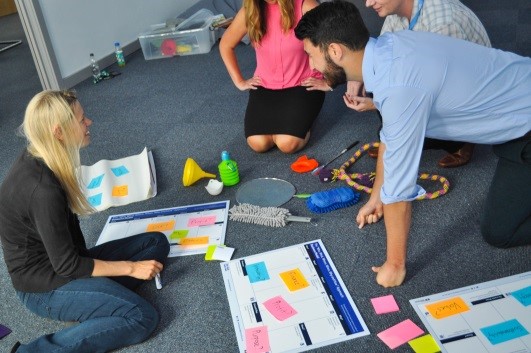
(2nd hour) The educator will signal that the ‘brainstorming’ phase of the task is over and now groups must decide on a final idea and begin to assess the commercial viability of their idea. Groups will use paper/whiteboards/ipads to begin sketching a prototype of their final idea with key information such as; product/service description, intended target market, intended pricing. The educator again circulates round the groups asking prompt questions and checking group progress. The educator gives each group formative feedback on their idea as the activity progresses.
(final 30 minutes) Each group will take turns to present their drawings and discuss their final idea with the whole group. The educator will provide feedback on each groups’ idea, particularly on any innovative aspects and commercial viability. Groups will be invited to comment on other groups’ ideas and to make suggestions for any additions or improvements.
Extensions – This activity can be extended to include a panel of industry experts. After groups have presented to one another and received educator and peer feedback, they can then prepare a final pitch to a panel of individuals drawn from relevant industry sectors thereby receiving ‘real world’ feedback on their ideas.
Assessment – this is a non-assessed activity and is designed to enable students to practice their creativity skills and opportunity recognition outside of the potential pressures of an assessed environment. It is an activity conducive to an environment of collaboration and discussion rather than competition and criticism.
Options for delivery – ideally this exercise would be undertaken in a physical space that is conducive to creative thought and action. For example a room with movable furniture, adjustable lighting, stimulating imagery or colours on the walls, or outside where the environment can interact with the chosen items.
Skill Development
- Creative thinking
- Innovative Design
- Team working
- Communication
- Opportunity Recognition
- Opportunity Evaluation
Resources:
- Post-its or similar sticky pads
- Pens
- Flipchart paper, whiteboards or ipads
- A creative space
- Items of low value (ideally £1) that are unbranded, unlabelled and do not have any instructions.
References:
Biggs, J. and Tang, K. 2011. Teaching for quality learning at University. 4th ed. Maidenhead: Oxford University Press.
Morris, M. Webb, J. Fu, J. and Singhal, S. (2013) A Competency-Based Perspective on Entrepreneurship Education: Conceptual and Empirical Insights, Journal of Small Business Management, Vol. 51, No. 3, pp. 352–369.
Quality Assurance Agency (QAA) (2018) Enterprise and entrepreneurship education. Guidance for UK higher education providers, The Quality Assurance Agency for Higher Education: London.