Objective:
- The learners will be able to explore the relationship between problem solving, creativity, innovation, divergent and convergent thinking
- An effective ice breaker provided at the start of a substantial training programme, learners work in small groups (minimum 2, maximum 5) to create solutions to problems they have identified that are pertinent to their working life (it is easier to identify problems from a first-hand perspective, in the context of every day life although other scenarios could be considered).
- The spin on this idea generation and problem-solving activity is that they are bound by the “10 Tenets of Chindogu” – rules by which the solutions must be created. This can be summarised by “solutions to problems that do not exist” or “the art of creating unuseless inventions.”
- This session will evidence the effects on providing researchers with the permission to play, explore and take risks, as they rediscover the innovative mindset of their younger selves and applying that to their current professional challenges.
- Key developments – cohort building, idea generation, innovation, problem solving, divergent and convergent thinking, risk taking, presentation and communication skills, enterprising mind set, thinking differently, taking action, having impact.
Overview:
Have you ever wondered how to improve a companion's accuracy in scratching your back or how to utilise the energy of crawling babies? Or how to deal with the problem of noodles that are too hot?
If you have ever worried about such things, and particularly if you have worried about them enough to come up with a solution, but above all if that solution is inherently impractical, then you could easily have all the qualifications to master the Japanese art of Chindogu.
This activity invites the audience (Early Career Researchers) to consider their daily professional challenges and create innovative solutions with a twist. All the solutions suggested must be bound by the 10 Tenets of Chindogu (explained below). Working in small groups, a frequently encountered challenge (ideally, placed in a current work setting) is agreed upon to solve with seemingly absurd yet possible solutions.
Chindogu invites experimentation and imagination. Absurd ideas create new neural pathways and opportunities for serendipity, which is a pre-requisite for ideation. This activity works particularly well with ECRs as they are often regarded as the academic elite and expected to present as perennially professional, putting to one side their curious and playful approach that they likely had as children. This is replaced with serious, technical and scientific language and behaviours, that can create a barrier between positive research outcomes and discoveries and those who would benefit from interacting with and understanding those outputs.
This activity results in new cohorts of learners bonding quickly over the fun and ridiculous nature of the process and outcomes. They have the opportunity to provide a short, interactive presentation to the whole group and so must master persuasive pitching in order to compete and win the coveted title of “Chindogu Master” for their cohort’s training programme.
Activity:
- The activity can be tailored to an hour or ideally it would last over at least 2 hours – depending on the numbers of smaller groups.
- It is a high energy, informal and fun activity that requires a space to accommodate at least one table per group, the opportunity for each member of the whole group to comfortably move around (the presentations are usually quite active and performance centred!) and a space within the room to store the resources needed for demonstrating the proposed solutions to the whole group.
- The session opens with a short presentation on what Chindogu is, using the 10 Tenets of Chindogu as a guide and clarifier (10 minutes):
The Ten Tenets of Chindogu (Excerpted from "101 Unuseless Japanese Inventions" by Kenji Kawakami; published 1995 by W.W. Norton & Co., NY)
1. A Chindogu cannot be for real use
It is fundamental to the spirit of Chindogu that inventions claiming Chindogu status must be, from the practical point of view, (almost) completely useless. If you invent something which turns out to be so handy that you use it all the time, then you have failed to make a Chindogu.
2. A Chindogu must exist
You're not allowed to use a Chindogu, but it must be made. You have to be able to hold it in your hand and think "I can actually imagine someone using this…almost." It has to be created by using existing and possible materials, ingredients and components.
3. Inherent in every Chindogu is the spirit of anarchy
Chindogu are man-made objects that have broken free from the chains of uselessness. They represent freedom of thought and action.
4. Chindogu are tools for everyday life
Chindogu are a form of non-verbal communication understandable to everyone, everywhere. Specialised or technical inventions, like a three-handled sprocket loosener for drainpipes centred between two under-the-sink cabinet doors (the uselessness of which will only be appreciated by plumbers), do not count.
5. Chindogu are not for sale
Chindogu are not tradable commodities. If you accept money for one you surrender your purity. They must not even be sold as a joke.
6. Humour must not be the sole reason for creating a Chindogu
The creation of Chindogu is fundamentally a problem-solving activity. Humour is simply the by-product of finding an elaborate or unconventional solution to a problem that may not have been pressing to begin with.
7. Chindogu is not propaganda
Chindogu are innocent. They are made to be used, even though they cannot be used. They should not be created as a perverse or ironic comment on the sorry state of mankind.
8. Chindogu are never taboo
The International Chindogu Society has established certain standards of social decency. Cheap sexual innuendo, humour of a vulgar nature, and sick or cruel jokes that debase the sanctity of living things are not allowed.
9. Chindogu can never be patented
Chindogu are offerings to the rest of the world - they are not therefore ideas to be copyrighted, patented, collected and owned.
10. Chindogu are without prejudice
Chindogu must never favour one race or religion over another. Young and old, male and female, rich and poor - all should have a free and equal chance to enjoy each and every Chindogu.


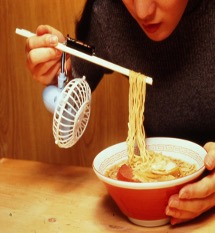
- Examples of existing Chindogu are presented – the most effective way is several photographs as the activity is best explained visually. (3 min)
- An overview of the session and the expectations of the participants are provided:
Instructions: Agree on a challenge to solve, provide possible solutions with the Chindogu rules in mind, create a user storyboard and a prototype using the resources provided. Pitch your idea to the wider group for judging by the identified decision maker. - Working in their existing groups, participants are invited to share with one another their daily challenges. What causes them frustration every day? What would they like to solve to make their lives happier in the workplace? Ideas are captured on large flip chart paper on the tables – all suggestions of the challenges they face are captured. (8 mins)
- As this is intended to be a high energy activity that encourages participants to step outside of their familiar, professional behaviour, it is valuable to encourage people to stand or use the space around them during their divergent thinking stage. Chairs can be abandoned, floors can be repurposed, walls and windows can be rethought.
- Once the paper is populated with lots of problems to solve, the group works together to decide on one issue out of all those presented that they would most like to unravel. This is through open discussion and eventually agreement. (4 min)
- With this challenge in mind, the group works together to provide potential solutions to the issue in hand. No idea is considered silly or unworkable at this stage. A successful Chindogu is something that often begins with the thought, “What if we could…” and unusual, innovative and imaginative ideas begin to come forward. All solutions must adhere to the 10 Tenets of Chindogu and the key one is to remember that all components of the solution must already exist and be possible – but presented as a whole, they are repurposed in a new way. Jet packs, time travel and invisibility cloaks aren’t welcome here. (30 mins)
- Once the solution has been decided upon, the groups can make full use of the “Resources Box” to physically create and manifest their ideas, to use as props and visual representations during their presentations. No digital technology is permitted – this is a fully analogue activity and the more creative the physical representation, the better. (30mins)
- Each group then presents their challenge, the proposed solution and the prototype to the wider group for evaluation from the “judges”. The criteria by which these are judged can include “most innovative use of an everyday object”, “most persuasive pitch”, “most effective stepping out of a comfort zone” (particularly pertinent for anyone who is uncomfortable with this new shift in professional behaviour and yet still immerses themselves in the activity) etc. Judges who are already involved in the programme work well here as this is a trust building exercise and so participants may feel that they are risking their professional integrity by stepping out of their comfort zone to immerse themselves in discovery through play. Inviting their supervisor, boss or funder might not work so well in encouraging participants to use their enterprising behaviours in this way.
- The winning group is then presented with a small prize each – chocolate medals work well (consider vegan and vegetarian options!), pens, a drinks token. Keep it small but useful!
- The activity is concluded by asking for open, spoken feedback from the groups on:
What worked well for you?
What did you learn about yourself re: communication, innovation, problem solving?
What would you do differently in your research/work/study/life as a direct result of taking part in this activity? (5-10mins) - It is worth taking photos of the creations that are presented as they are visually interesting, fun and memorable. With permission gained from participants, sharing the photos on social media helps to share your activity with colleagues and external networks, which is of particular interest to them if you have used the activity in an unusual way or with an audience who wouldn’t normally have the opportunity to become involved.
Skill Development:
Through this interactive session, the learners gain several benefits:
- The session is designed to encourage an enterprising mindset – to see the world’s challenges from a new perspective, try new approaches and exist outside of the participants’ usual behaviours and attitudes.
- The activity evidences the impact of creatively tackling problem solving whilst encouraging a playful approach that can often be lost as we mature through our educational experiences. Inviting adult learners (researchers in particular) to remind themselves of their childlike imagination and creativity can help to unlock enthusiasm, inspiration and collaboration to solving real world issues.
- The session is particularly useful in bringing together professionals who are new to one another and new to this style of learning. It enables them to literally stand up from their conference seat and conference style approach to new information and become immersed in contributing their ideas collaboratively in order to complete the task, possibly win the challenge and develop their communication skills within their smaller groups but also establish themselves within the wider group.
- At the end of the activity, learners report to feel energised, happy, surprised by what they could achieve with this unusual brief and more integrated into their learning cohort. If the session is for adult learners (ie: researchers / management teams etc) they will generally have felt this approach is out of their ordinary. However, by completing this task together, they develop a sense of trust in themselves, one another and the process to allow creative thinking to be a priority and also a fun experience.
- Although the solutions they come up with during the task are not credible in the traditional sense, the process of thinking outside of their usual self-imposed boundaries in the workplace, has been proven to help participants to return to this work place and complement traditional methods of problem solving by including a playful, imaginative approach to creating solutions.
“I feel that I have gained many skills that I can use in everyday situations (academia, industry, social life)” (ECR, Newcastle University)
“Chindogu is a fantastic method in developing personal skills in a playful way that can be applied to future careers” (ECR, Durham University)
“I have learned a lot and improved myself after this training. Chindogu has opened my mind to a new way of approaching problem solving. I would like my friends and colleagues to have the same confidence and mindset that this training has given me.” (ECR, Northumbria University)
“I learned things I did not expect to learn and gained confidence and enthusiasm – it’s the best training I have ever done! It should be made compulsory for all researchers to help them think differently, join multidisciplinary groups to solve problems from a new perspective.”
(ECR, University of Sunderland)

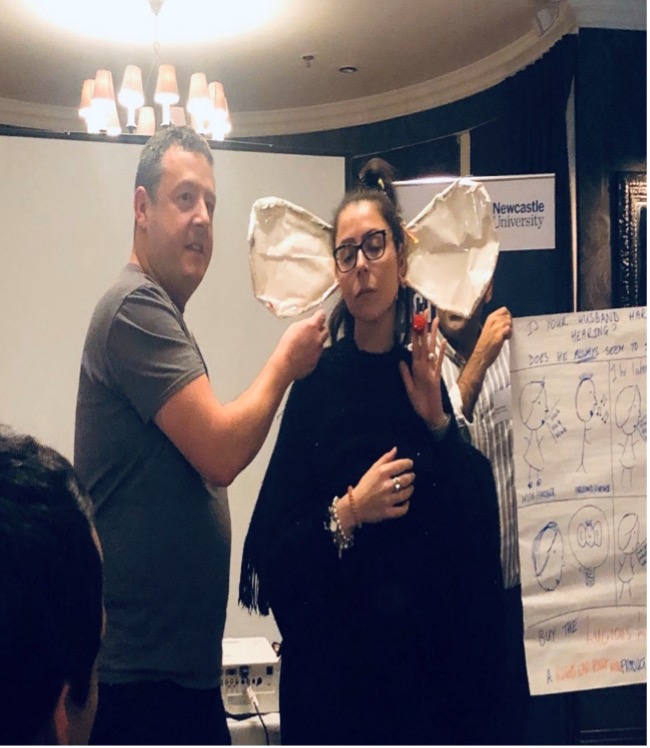

Photos provided with permission. Taken during Chindogu sessions from Action for Impact training programmes November 2019 and February 2020. All participants are early career researchers from the 4 Northern Accelerator partner Universities (Photographer – Jenny Brady)
Resources:
On each table:
- Flip chart paper
- Flip chart pens
- Post It notes
- Blu Tac
- Sweets / treats for energy!
In the resource / junk box: (I recommend all items are dry and not wet – eg: no paint)
- Coloured card
- Pipe cleaners
- Cardboard boxes
- Play doh / Plasticine / play clay
- Sellotape / sticky tape
- Scissors
- Lego / building blocks
- Cardboard tubes
- Jar lids
- Tin foil
- String
- Glue sticks
- Any other household item you can include that could be recycled and repurposed into a Chindogu prototype.
References:
Kawakami, K., 1996. 101 UN-Useless Japanese Inventions. 3rd ed. WW Norton & Co, p.13.
Youtube video examples:
Youtube video Action for Impact training: