Objective:
Following the steps in the below guide, the learner will develop a comprehensive business plan.
Overview:
So you want to write a business plan? Right well let’s start with the basics; a business plan is a written document that describes a business, what it does, or is going to do, and how. It’s also a ‘living document’, something that you as the business owner should look to for goals and be constantly updating to keep it in-line with new developments as the company grows.
This guide provides an outline for how you can put together my version of a business plan and at the end, points you to some further reading to develop your skills. This is a version that I have developed over years of writing them so it combines a lot of information from different sources and while you can find other templates on the web, I am confident that this is the best starting point. However, good business planning is personal, it reflects you and your business AND so don’t be afraid to deviate away from this guide, or modify it to suit your own requirements.
Note: You should use this Guide alongside the Pro-Forma Business Plan (see resources)
Activity:
Where do I start?
Let’s start with the key question: why are you writing this plan? There are three basic motivations for writing a business plan:
- Developing an idea
- Preparing for Investment
- Strategic management
Remember that each of these audiences will be looking for different things in your plan that you will need to provide. External investors will want the maximum information about the opportunity and sound financials presented in a formal manner, whilst plans for yourself or employees might be “lighter” but need more detail on operational issues, so first off decide who you are writing this for as that affects the whole structure and tone of the plan.
Note: This guide is mostly going to deal with a plan aimed at gaining investment or presenting a start-up business but the basic elements can be modified to suit a range of needs or audiences.
Once you’ve worked that out get researching: a good business plan is based on sound research. If you haven’t done any research how can you hope to discuss the market, competitors, pricing strategies and operational issues in a believable manner?
There are two types of research you need;
- Primary: Material you collect directly such as questionnaires, interviews and data from focus groups.
- Secondary: Material you get from books, newspapers or the internet.
A good business plan should show evidence of both of these types of research to support its case.
Then...
This might sound basic but get a computer with word processing and spreadsheet software; get a template set up in your word processor (so the whole plan looks the same) and choose a simple, professional font (some people recommend a mixture of Ariel for titles and Times New Roman for the body of the text).
Note: The reason for using different fonts is that Serif fonts such as Times New Roman actually encourage people to read documents as the Serif’s (the little pointy bits on the letters) actually make reading easier for most people.
But as long as it looks clean and easy to read you should be fine: plus always add a basic footer, for organisation.
Remember page numbers, and don’t go crazy with headings; you probably only need two levels, Headings and Sub Headings: if you start having too many it will just get confusing, and remember if you organise this correctly most modern word processing programmes will then be able to automatically generate your contents page.
So…
If you’ve been following me so far, then by now you should have:
- A clear reason for writing the plan, which will help you set the tone and decide on the structure
- A pile of research, that will provide you with support for what you’re going to be saying about your business
- Concept of basic layout and design.
What you need next is structure...
Note: Calls to Action, I am going to talk about calls to action (a lot) so if you’ve never heard this term before here’s a quick bluffers guide. In marketing there are two types of writing, passive and active; passive writing tends to be vague, awkward and complex most importantly it doesn’t prompt people to do anything. Active writing is much more direct and pushes the audience to do something. In your plan you need to focus on active writing and use Call’s to Action.
These are statements that drive the reader to continue through the plan, it could be an interesting hook, a great opportunity or an exciting voice from the writer, however you achieve writing them Call’s to Action are key to a good business plan as they drive people through the document and generate interest.
The Structure
Structuring your business plan is 50% skill 50% art and relies a lot on you understanding what information the audience will be looking for in order of priority. The more times you practice this skill the better, but to get you started I’ve put in a quick crib which gives you an overview of the structure I will be using in this guide.
Contents Page Crib
- Cover Sheet
- Contents Page
- Executive Summary
- Corporate Data
- Business Vision
- Mission Statement
- Corporate Values
- Brief History of the Company
- Latest Financial Data
- The Product(s) / Service(s)
- The Market
- Competitor Analysis
- Marketing Strategy
- The Management Team
- Infrastructure
- SWOT Analysis
- Financial Documents
- Risk Statement
- End
Ideally a plan should be between 20 – 40 pages long and remember that this structure isn’t definitive, you may deviate from it, that’s up to you and those choices will become easier as you develop more experience.
Confidential or Not?
This is something I always get asked, should I put a confidentiality statement on my business plan?
So here’s my definitive answer . . . Do you have anything in your plan that represents a real risk to your Intellectual Property (IP) something that would be worth copying, or that would totally compromise your business if it were to become public? If the answer to this is YES and you intend to show this document in the public arena then you definitely need a confidentiality statement! If however you don’t have this kind of data in your plan, or it’s not going to be a public document then you have a choice and it’s down to you and what you’re comfortable with.
Executive Summary
You spend two weeks planning and writing a great document, you pour your heart and soul into it and then in a crushing move an investor like me only reads the first page – the reality of business planning is that the most important page you will write is the executive summary; it’s a plan in miniature which captures all the pertinent points of your whole document.
This summary sets the tone for the rest of the plan and determines how eagerly the document is read: use it as an opportunity to sell your vision and objectives, but don’t over hype your ideas, make it balanced but exciting. Think of it as a call to action, the action being reading the rest of the plan: if it doesn’t grab the reader you’ve little hope they will continue.
Note:Hit the Purpose of the Plan in the first sentence i.e. ‘MDK Inc. Is seeking funding of £1million in order to . . .’ anyone picking up your plan needs to know straight away why they are reading this and if it’s something they are going to be interested in.
The executive summary needs to contain the following information basic info:
- Who are you?
- What do / will you do?
- What do you want?
- Why should I [the audience] read this?
Note: Remember all this should read as one big call to action
In my opinion you should always write this section last: treat it as an exercise in reviewing your ideas and use it to make any tweaks you need throughout the plan.
Corporate Data
The first element of the main body of your plan should comprise some basic corporate information;
- Company Name.
- Company Number (If Ltd), if you’re not a limited company state clearly what form your company takes.
- Business Status (Trading / Not Trading).
- Name(s) of Director(s) / Owner(s) / Partner(s) / Trustee(s) and if it’s not divided equally their % equity owned.
- Address of Head Office.
Business Vision
What’s the vision for the business, do you want to be the most profitable t-shirt company in the UK, the first company to develop a new technology or improve your production systems your vision should be a couple of paragraphs about where the company is heading and why. If you don’t have a vision, then I have a simple question for you: why are you writing a business plan?
Mission Statement
A mission statement gives a clear indication to your readers and your employees about your company and where it’s heading. It tells them what you will be working towards and achieving along with what you expect from them. Your Mission Statement should be a dilution of your business vision into one key sentence. I used to have a mentor who believed in this so much that he would tell students, that if they couldn’t sum up a business in one sentence then they didn’t have one worth looking at!
Note:Your mission statement should also reflect your Unique Selling Point (USP) and writing these two at the same time will help them feel as if they fit together and can be a good exercise in developing concise business terminology.
Corporate Values
It’s always good to give a nod to corporate values; perhaps it’s the unique values of your brand that you want to discuss such as customer service or quality, or maybe it’s about your plans for corporate social responsibility as a reflection on wider community / environmental values, either way this section will help an investor understand key elements the underpin the foundations of the enterprise.
If you’re not sure you can leave this section out of the plan, but a word of warning, for me this is one of the most important sections in any plan as the values highlighted here tend to say a lot to me about the author and if I think I can work with them and I know I’m not the only person who feels that way.
Brief History of the Company
Keep this BRIEF! If it’s a page it’s too long, talk honestly about the company, pick out key highs and lows and try to present a history that’s relevant to your audience.
Latest Financial Data
If you’ve been running the company for a while and have up to date financial data which looks enticing, consider putting this section into your plan. Use it to showcase some of the financials you will present later, especially any that might wet an investor’s appetite; again keep this brief, relevant and punchy.
The Product(s) / Service(s)
The next element of the plan should really be a discussion of your product(s) and / or service(s) it’s a chance for the audience to really start to get to grips with your business at an operational level and understand what it does.
Note: Try to avoid too much technical jargon in this section; chances are your audience might not be product specialists, if you can’t avoid it make sure you put in a glossary to explain the terms in context. Once you’ve done this trial it on a family member or someone with little understanding of what you do, to see if they can make sense of it, if they can you’ve cracked it!
This section needs to include;
- A description of the product(s) and / or service(s) you are going to sell.
- Some background as to their development.
- Their USP’s (What differentiates them in the marketplace?).
- Pricing Strategy.
- Any discussion of patent / IP protection relating to them.
- Any issues relating to their manufacture / facilitation.
- A view of them into the future.
Remember that in this section you really need to be selling these for all they are worth, use photo’s, testimonials, graphs and diagrams; really make everything look attractive by investing time and care in this section . . . if your offer doesn’t look like a great opportunity you risk losing the audience right here.
Note: when it comes to pricing strategy you have a number of choices, but here are some of the most commonly used:
- Economy Pricing: This is a no frills low price. The cost of marketing and manufacture are kept at a minimum and you charge the lowest price possible. Supermarkets often have economy brands for soups, spaghetti, etc.
- Penetration Pricing: The price you charge for your product(s) and / or service(s) is set artificially low in order to gain market share. Once you have this, the price is increased slowly; a good example of this is the special offers used by companies like Sky or BT to bring customers in before ramping up costs.
- Cost Plus Pricing: This is the simplest form of pricing, take your fixed + variable costs and add a set % margin (normally a minimum of 20%).
- Psychological Pricing: This approach is used when you want the consumer to respond on an emotional, rather than rational basis. For example 'price point perspective' is the use of 0.99p rather than a whole number to give the customer the feeling of saving money.
- Product Line Pricing: Us this where you have a range of products or services, the pricing reflect the benefits of parts of the range. For example car washes: a basic wash could be £2, wash and wax £4 and the whole package £6.
- Product Bundle Pricing: Here you combine several products in the same package. This also serves to move old stock. Videos and CDs are often sold using the bundle approach.
- Promotional Pricing: Pricing to promote a product is a very common application. There are many examples of promotional pricing including approaches such as BOGOF (Buy One Get One Free).
- Premium Pricing: Use a high price where you have a really unique product or service. This approach is used where a substantial competitive advantage, think Mercedes, Ferrari or Malona Blanic.
The Market
Here’s where all the lovely research will start to come into play… in this section you need to discuss the market for your product, so let’s start with some terminology:
- B2B: Business to Business, means that your core customer is other business
- B2C: Business Consumer, means that your core customer is individual consumers
Once you’ve worked this out you need to spend some time discussing your typical consumer, for this you are going to need to understand demographics:
- Demographics are the characteristics of human population, by which that population can be divided, common demographics include:
- Sex
- Race
- Age
- Income
- Disabilities
- Educational
- Employment status
- Location
You can then use this data to show that you’ve given some thought to the specifics of who will buy your product (through a discussion of some demographic factors), where they are based and why they will choose you over other brands (this point will link to the next section).
If you have already sold product(s) and / or service(s) you could use this as justification for any of the statements you make in this section.
Competitor Analysis
Right, it’s time to show that you understand who your competitors are and whether you are doing better, or worse than them, to achieve this you need to present some data and discuss its implications for your business. That data should include;
- Name, Location and Business Size.
- Product / Service.
- Price(s).
- Strengths.
- Weaknesses.
Note: To make it easier to review consider presenting this data as a table, rather than lots of paragraphs.
Marketing Strategy
Developing a marketing strategy is vital for your business. Without one, your efforts to attract customers are likely to be haphazard and inefficient.
The focus of your strategy should be to make sure that your products and services meet customer needs and that you develop long-term and profitable relationships with those customers. To achieve this, you will need to create a flexible strategy that can respond to changes in customer perceptions and demand. It may also help you identify whole new markets that you can successfully target.
The purpose of your marketing strategy should be to identify and then communicate the benefits of what your business offers to your target market, drawn from your USP.
FAB’s
- Features: The core elements of a product (the fact that a TV might have internet connectivity for example).
- Advantages: The advantage is what the customer gets from this (i.e. that they can now access and interchange internet and TV services using a single system).
- Benefits: This is why the customer really wants it, in this case it’s because it saves money, space, and a lot of time through not having to change from one piece of equipment to another
Note: You need to sell the benefits of your product as these are what the customer cares most about.
You need to spend time in this sections discussing the types of marketing activity you are going to undertake, why (linking to the demographics in the previous section) how these will all work together (and support each other) and how much they will cost.
Note: You may also want to use this section to discuss your Competitive Advantage this is when you are able to deliver the same benefits as your competitors but at a lower cost (cost advantage), or deliver benefits that exceed those of competing products (differentiation advantage) this debate should draw on the previous sections.
The Management Team
The point of this section is to reassure potential investors that you have the people and skills to achieve the plan. You need to start this section with short overview of the management team, structure and numbers.
Note: Think about using an organisational chart to show the structure of the company:
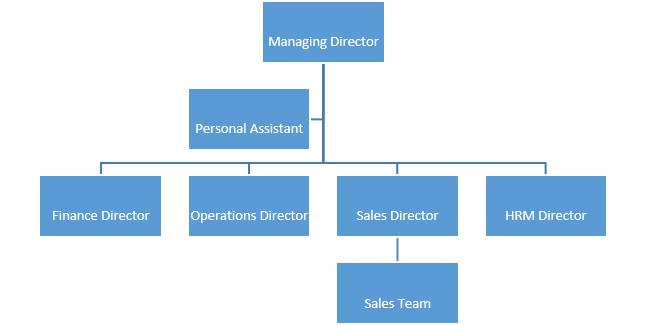
Follow this up by giving brief descriptions of each role; the people who occupy them and their experience, CV’s can be attached in an annex.
You may also want to use this as an opportunity to highlight any skill gaps in your business and discuss how you intend to fill them.
Infrastructure
Sometimes referred to as operations, this section should help a reader understand the business and how it operates, you need to include the following elements, this list is a minimum;
- Describing the Production / Design of your Product / Service and its Delivery.
- Your Credit Control Systems.
- Health and Safety Controls.
- Environmental Controls (if Applicable).
- Insurance.
- Other Legal Requirements (Protection of Children for Example).
- Suppliers List, Showing you can Source the Relevant Materials (if Applicable).
- Details of your Premises.
- Details of your Equipment.
Remember throughout this section of the plan re-enforce your core competencies what you are really good at! Using wording that supports this like; World leading; do you have a unique patent? An unassailable product design? Staff no one else can employ? If you do make sure that this is highlighted here
Some business plans may require a fuller exploration of the operation elements of the company, if this is so then a mini operational plan will be required but this tends only to be necessary when the plan is to be used operationally or there are concerns surrounding the business operations.
SWOT Analysis
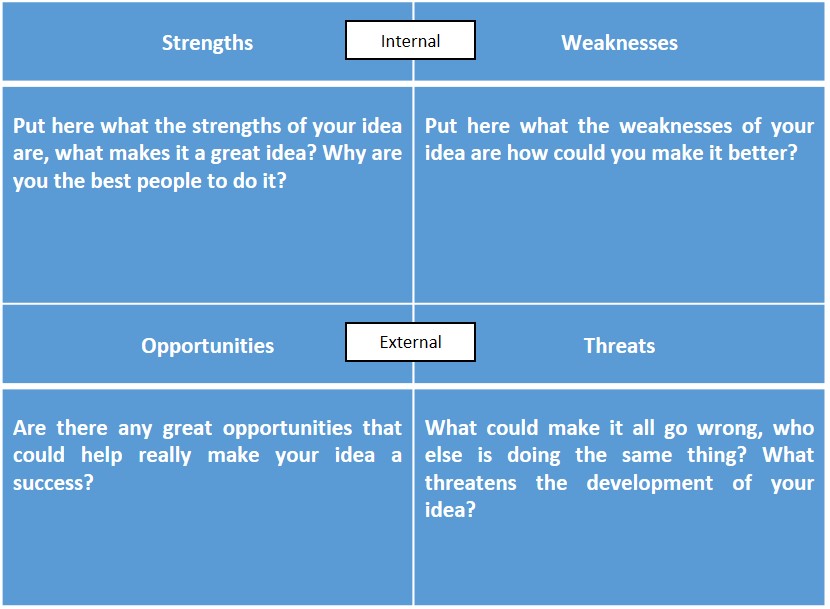
A SWOT analysis is a planning method used to evaluate the Strengths, Weaknesses, Opportunities, and Threats involved in a business idea. It can be very helpful in identifying competitive advantages, areas for improvement or possible threats to your idea and is a mixture of internal and external review. In this case we are using a SWOT to summarise the key elements of your plan and provide a concise overview to investors.
The diagram below shows how you might lay out a SWOT:
Financials
The numbers are perhaps the most important part of any plan, any investor will probably skip the entirety of your plan and read these figures first to decide if your business is worth a second look. Depending on the state of your business (trading or not trading) there are up to 8 key documents that you will need that make up this section, these are:
- Sales Forecast - a prediction of what sales will be achieved over a given period, anything from a week to a year.
- Capital Outlays - expenditures to acquire, significantly expand, repair, maintain, or renovate fixed assets such as buildings or machinery.
- Employee Costs - the costs of employing people in the business.
- Operating Costs - the recurring expenses which are related to the operation of a business.
- Expenditure Commentary - a commentary discussing the expenditure
- Profit and Loss Account - an account compiled at the end of an accounting period to show gross and net profit or loss.
- Balance Sheet - a record of the financial situation of an institution on a particular date by listing its assets and the claims against those assets.
- 12 Month Cash Flow - the excess of cash revenues over cash outlays in a given period of time (not including non-cash expenses).
Along with these, you may need to provide a commentary highlighting key points so that potential investors can make an informed decision – and remember be honest, any investor worth their money will check your data against as many sources as possible.
Note: Outlines of some of these documents are available as excel files.
Risks
Finally you need a section detailing the potential risks of your venture so that any investor can decide if this is the level of risk they want to take, these risks should be summarised from the rest of the plan, along with any not otherwise made explicit in the rest of the document.
Skill Development:
I’ve Started So I’ll Finish . . .
Finally remember that this guide is just that, a guide your plans should be personal showcasing your business to an identified audience, to quote Douglas Adams:
Don’t Panic!
Business planning is a skill and practice makes perfect so just keep going the more you work at these plans the better you will get, If you can pull all of the data listed in this guide together into a concise plan you will have achieved a lot and be well on your way to writing great plans and focusing your enterprises.
Resources:
References:
These are books I recommend on business planning:
- Richard Stutely (2006) The Definitive Business Plan: The Fast Track to Intelligent Business Planning for Executives and Entrepreneurs (Financial Times Series) (Paperback) Financial Times; ISBN-10: 0273710966
- John Mullins (2006) The New Business Road Test: What Entrepreneurs and Executives Should Do Before Writing a Business Plan (Financial Times Series) (Paperback) Financial Times; ISBN-10: 0273708058
- Paul Barrow (2005) The Best-Laid Business Plans: How to Write Them, How to Pitch Them (Virgin Business Guides) (Paperback) Virgin Books; ISBN-10: 0753509636
These are websites I recommend on the topic: